Woodworking Posts

Makers & Shakers: 009

Do You Like This Article?

Sign up for my weekly email newsletter and join thousands of others and be the first to know of new content like this!

Welcome to episode #9 of Makers & Shakers, a show that highlights people shaking it up in the world of woodworking, art, metal, crafts and building.

Making Wood Veneer Rings

The New Bandsaw Box Book

Support me on Patreon

Amazon Tool of the Week: Home Made Modern Book

Making It Podcast

Makers & Shakers: 009 Read More »

How to Make Deep Mortises When You Aren’t a Timber Framer

FORP_finished_mortise_IMG_9709

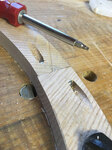
One of the defining characteristics of the heavy French bench is its joinery – the top and legs are joined with a joint that is one-half through-tenon and one-half sliding dovetail. The sliding dovetail is the easy bit. Saw the walls. Knock the waste out with a chisel. Clean the floor with a router plane. The through-mortises are trickier. It is more than 5” deep, 6” long and usually 1-1/4” […]

The post How to Make Deep Mortises When You Aren’t a Timber Framer appeared first on Popular Woodworking Magazine.

How to Make Deep Mortises When You Aren’t a Timber Framer Read More »

Sandpaper Sharpening & Honing, Part 2

Sharpening a chisel on a sandpaper plate

In my last post, I showed how I use adhesive-backed sandpaper as a sharpening medium in our school classroom. Although adhesive-backed sandpapers have become the gold standard in tool sharpening, I find that in many cases conventional sandpapers will do a good job, too. There are a few ways you can build a sharpening plate to accommodate conventional sandpaper. Use double-sided adhesive tape to affix the sandpaper to a flat […]

The post Sandpaper Sharpening & Honing, Part 2 appeared first on Popular Woodworking Magazine.

Sandpaper Sharpening & Honing, Part 2 Read More »

Make a Shaker Firewood Box, Part 1

Shaker Firewood Box

With winter approaching, we’ve had a new wood burning stove fitted at home. Our joinery workshop (G.S. Haydon & Son) provides ample fuel and it’s a great way to save on the utilities bill and have that unique and comforting sight of a fire during the dark and cold months. My indoor firewood box design is based on a “Log Bin” that was build by the Shaker Craftsmen at New […]

The post Make a Shaker Firewood Box, Part 1 appeared first on Popular Woodworking Magazine.

Make a Shaker Firewood Box, Part 1 Read More »

How to Make Wood Rings / Bentwood Rings

Making these wood rings is pretty simple and can be done without many tools. Basically we’re going to take some veneer and boil it in water to make it more pliable. We’ll then coil the veneer onto itself and bonding it with CA glue. You’ll find these rings are much stronger than just drilling a hole into wood and cutting the outside shape. That’s because we won’t have any weak points with endgrain. There will be many layers with straight grain laminated with glue which will make them very strong and durable. I’ll also show you how I added these accent lines with a contrasting veneer between 3 coils. Let’s get started.

Items and Supplies Used

Do You Like This Article?

Sign up for my weekly email newsletter and join thousands of others and be the first to know of new content like this!

wood veneer ring

How to Make Wood Rings / Bentwood Rings Read More »

How to Make Wood Rings / Bentwood Rings

Making these wood rings is pretty simple and can be done without many tools. Basically we’re going to take some veneer and boil it in water to make it more pliable. We’ll then coil the veneer onto itself and bonding it with CA glue. You’ll find these rings are much stronger than just drilling a hole into wood and cutting the outside shape. That’s because we won’t have any weak points with endgrain. There will be many layers with straight grain laminated with glue which will make them very strong and durable. I’ll also show you how I added these accent lines with a contrasting veneer between 3 coils. Let’s get started.

Items and Supplies Used

Do You Like This Article?

Sign up for my weekly email newsletter and join thousands of others and be the first to know of new content like this!

bentwood rings


Cut veneers

Step 1: Cut the Veneers

First you need to start off with thin veneer with very straight grain. Wavy grain will chip and break during the bending process. I’m using a scrap board with a veneer saw to cut some thin strips. This could also be done with a utility or exact-o knife.


Make veneer on tablesaw

Step 2: Make Your Own Veneer

If you don’t have access to veneer you could easily cut your own on the table saw.


Boil the veneer

Step 3: Boil Veneer

Now you’ll want to boil the veneer in water for 60 minutes. This will make it extremely pliable.


coil veneer

Step 4: Coil Veneer

While still wet you’ll then want to coil the strips onto itself. You don’t need to coil it to the size of the rings  just yet. We want to coil it just enough where it doesn’t break and then wrap it in masking tape to keep it in that position.


Wrap in masking tape.

Step 5: Wrap Veneer

After you wrap it in masking tape allow it to dry completely in this position. Once dry it will retain the shape and allow for it to be coiled even tighter.


Ring finger size

Step 6: Ring Finger Size

For the next few steps you will need something the circumference of your ring finger. Here I’m using a large drill bit and wrapping it with masking tape to the exact size.


Sand one end of the veneer

Step 7: Sand One Edge

On the end of the dried veneer sand the tip down to a fine point. This will allow a seamless transition for the first layer.


Wrap and glue

Step 8: Wrap and Glue

Now it’s just a matter of wrapping the veneer around our sized blank and adding CA glue between the layers. The metal ruler seen here is used to hold the remainder of the piece out of the way. Work just a small section at a time winding it as tight as you can and holding it in place until the glue sets. For this style of ring you’ll need to repeat this process 2 more times.


Sand outside edges of veneer

Step 9: Sand Edges

Now you’ll want to sand the outside edges flat.


glue up layers of veneer

Step 10: Glue Accent Lines

For the contrasting accent lines cut out two pieces of veneer to the size of the ring. We’ll then just glue the flat veneers down by sandwiching all the pieces together being sure to align the coiled pieces as best you can.


align veneer coils

Step 11: Aligning Coils

Do your best to align the coils between the contrasting veneers.


Drill through veneer

Step 12: Drill Through Veneer

Now you can puncture through with a drill bit and sand the inside.


dremel tool

Step 13: Sand the Inside

A Dremel tool works great for sanding the inside but you could also use a rat tail file.


Sand on lathe

Step 14: Sanding the Outside

If you’re lucking enough to have a lathe you can speed up the sanding process. If not, then sanding by hand will work just fine.


sanding

Step 15: Sanding the Edges

I’ll then sand down the edges and some final sanding on the inside.


finish rings

Step 16: Finishing Part 1

For the finish I apply one coat of boiled linseed oil.


spray polyurethane

Step 17: Finishing Part 2

After apply a coat of boiled linseed oil I’ll apply 10 coats of spray polyurethane. Allowing 1 day to dry between each coat.


wood veneer ring

wood veneer rings bent wood rings

How to Make Wood Rings / Bentwood Rings Read More »

Scroll to Top